
When students start the school day hungry, it can be harder to focus, learn, and thrive. Breakfast After the Bell (BAB) is an approach to administering the School Breakfast Program where breakfast is served after the instructional day begins. It gives students the opportunity to eat breakfast alongside their peers as part of their morning classroom routine, helping more students start their day with a nutritious meal.
Over the past four years, Federal Way Public Schools has steadily expanded Breakfast After the Bell, making breakfast more accessible to more than 21,000 students across 35 schools. Today, BAB is available at every elementary and K–8 school and nearly all secondary schools in the district. The results show what’s possible when school breakfast is treated as an essential part of students’ ability to learn.
Closing the Breakfast Gap
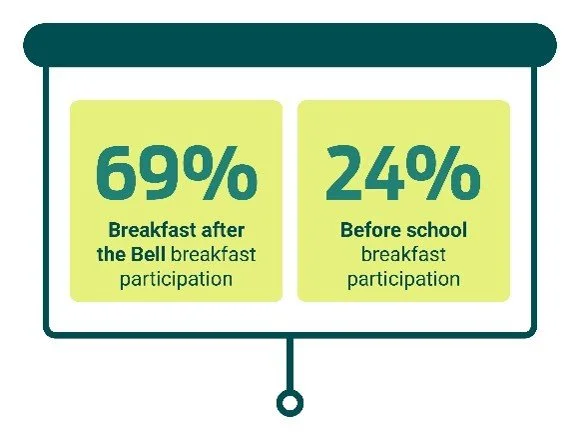
In Federal Way, breakfast participation is significantly higher at schools offering Breakfast After the Bell. In these schools, on average, almost 70% of students access breakfast each day, compared to just 24% of students in schools serving traditional before-school breakfast.
The difference is also significant from an equity perspective. At schools offering Breakfast After the Bell, breakfast participation comes within four percentage points of the percentage of students eligible for free and reduced-price meals. At schools serving breakfast in the cafeteria before school, the gap is 43 percentage points. BAB helps schools reach more of the students who may benefit from school meals.
Changing the School Day
Expanding Breakfast After the Bell is about more than serving more meals. It’s about creating school environments where breakfast becomes a normal, supported part of the day.
“I really like breakfast in the classroom. I like that we have more of a community feel to breakfast, and it's a calmer start to the day.”
— Sara Crandell, Kindergarten Teacher
Teachers see the value of making breakfast a regular part of their students’ mornings. A majority of surveyed teachers reported a calmer start to the day and over half reported noticing fewer student requests for snacks or complaints of hunger.
Perhaps most telling, over 80% of teachers said they supported continuing Breakfast After the Bell the following year. That support matters. Successful implementation requires teachers, nutrition staff, administrators, custodians, and students to adapt their routines and make breakfast part of the school day.
The district has also examined school discipline and referral data. During the 2025–26 school year, elementary and K–8 schools where Breakfast After the Bell had been in place for at least two years averaged about 30 fewer discipline referrals per month than in the previous school year. While these findings don’t establish that Breakfast After the Bell alone caused the reduction, they offer another encouraging perspective on students’ school-day experience.
A Model for Other Districts

Federal Way Public Schools demonstrates what’s possible when school districts prioritize breakfast access as part of their commitment to student well-being and learning. Piloting, learning from experience, expanding participation, refining its approach, and adding on until all schools in the district provided this valuable access to students.
Across Washington, hundreds of schools have strengthened and expanded their Breakfast After the Bell programs. Federal Way Public Schools offers an example of how districts can start small, learn what works, and build toward lasting change. When breakfast becomes part of the school day, more students have the opportunity to eat, connect with their peers, and begin the day nourished and ready to learn.